

In a personal injury case, evidence is everything. It is not enough to say you were hurt. You must prove how it happened, who was responsible, and how the injury changed your life. That proof must follow strict rules. If evidence is presented the wrong way, it can be excluded. If an objection is missed, it can weaken a case. Trials are not just about facts. They are about admissible facts. That is where evidence law comes in.
What Is “Virginia Evidence for the Trial Lawyer”?
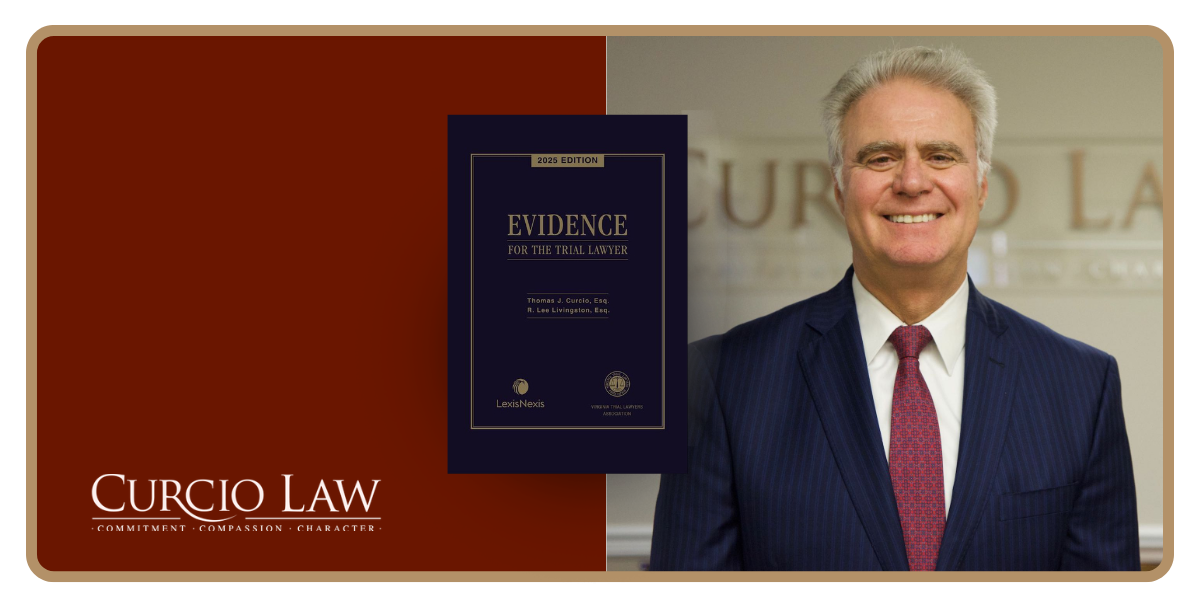
Co-authored by Thomas Curcio, published by LexisNexis and now in its 12th edition, Virginia Evidence for the Trial Lawyer is widely regarded as a foundational resource for trial lawyers across the Commonwealth. It is used by both new and seasoned attorneys as a practical, authoritative guide to the rules governing evidence in Virginia courts. In short, it explains how evidence is collected, challenged, and presented in a trial. It also includes an appendix with the Federal Rules of Evidence and addresses how state and federal rules interact.
Why Evidence Rules Matter in a Personal Injury Case
In a personal injury case, the outcome often turns on what the jury is allowed to hear, not just what happened. Consider a few real-world scenarios:
A crash victim suffers chronic neck pain. The treating chiropractor has seen the patient dozens of times and understands the progression of the injury. But can that chiropractor testify about cause? About future medical needs?
Suppose the defense finds a photo of you smiling at a family barbecue three weeks after your crash. They argue it proves you are not seriously injured. Can they introduce it?
Many clients assume the police report will simply be handed to the jury. But in Virginia, large portions of a police report are hearsay. The officer can testify to what they personally observed. But statements from witnesses recorded in the report are often not automatically admissible.
Virginia law draws specific lines around how documents, digital evidence, police materials, and witness statements may and may not be used in court. If those lines are ignored, critical proof can and will be excluded. If they are understood and respected, that same proof can become decisive.
These are not procedural formalities. Evidence rules determine:
- What documents come into court
- Which opinions are allowed
- How experts can be challenged
- Whether damaging statements are excluded
- What the jury ultimately considers
A case can be won or lost on these details.
Confidence Backed by Substance
Personal injury clients should not need to understand hearsay doctrine or authentication rules. That is the attorney’s job. But you should understand this: trials are governed by strict evidence rules, and mastery of those rules can change outcomes.
When your attorney writes Virginia Evidence for the Trial Lawyer, you are not just hiring someone who tries cases. You are hiring someone who teaches other lawyers how evidence works. In a courtroom where every detail matters, that expertise can make all the difference.