
By Thomas J. Curcio
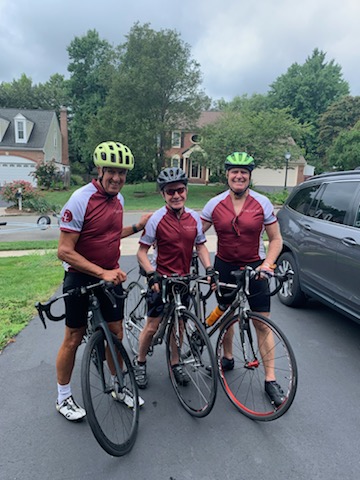
As an avid cyclist and a personal injury attorney, it is only natural that I am entrusted with many bicycle accident cases in our area. But just as importantly, I also know firsthand what it feels like to be seriously injured in a bicycle crash, to be thrown over my handlebar, suffer a significant injury, and work my way through the long path to get back on the saddle.
It Happened in a Split Second
I was out riding with a long-time cycling buddy, heading toward Hains Point. It was a routine ride, nothing out of the ordinary. At one point, I took one hand off the handlebars to wave to a friend behind me. In that moment, my balance shifted, and ahead of me was a slick railroad tie embedded in the path protruding ¼ inch above the pavement. As the path curved slightly to the right, and I had minimal weight over the handlebars, my front wheel hit at an angle and slid sideways stopping the forward momentum of the bike. I was pitched over the handlebars and thrown forward. I was only going about 11 miles per hour, but I still flew several feet before hitting the pavement. Even at moderate speeds, the human body carries a surprising amount of momentum. The impact was wildly unexpected.
Knowing You’re Hurt, But Not How Bad
I knew right away I was hurt but not exactly how badly, until I attempted to stand up. When I could not stand, the fear began to flood in. I hear about serious injuries every day, and almost automatically started taking inventory. Head…clear. Back…seems fine. Then I got to my leg, and I knew immediately something wasn’t right.
I had suffered a fractured acetabulum. In plain terms, the ball of my femur was driven into and fractured the socket of my hip. It’s the kind of injury that, almost instantly, turns your normal life into something you have to fight your way back to.
The Reality of Recovery
The accident is only the beginning. What follows is what many people, me included, are not prepared for.
Pain. Surgery. Limited mobility. Stolen time, so much time.
I spent 10 days in the hospital after emergency surgery. After I returned home, I had multiple home visits by a physical therapist. It was quite concerning when during the first session I could not move my left leg at all, not sliding side to side laying on the bed or flexing my knee. Nothing but dead weight. Pushing myself a bit too hard, I developed an infection at the surgical site and had to be readmitted to the hospital. That meant more treatment, more antibiotics, and more time before I could begin to think about recovery. By that point I was actually looking forward to starting the months of out-patient physical therapy.
I think the hardest part of the entire accident for me was not being able to function the way I was used to. Not being able to work the way I wanted to. Not being able to help around the house, to interact with my wife and teenage children as I was used to.
So, I can sympathize with many of my clients who, like me, tried to push through it. Went back to work or family responsibilities to soon and get set back in their recovery. It’s not easy going from an active life to being told to slow down. It wears on you, not just physically, but mentally too.
What I Carry Into My Practice
Injuries go far beyond what shows up on an X-ray. The real impact is in the disruption to your life, how everything from work to daily routines suddenly becomes difficult.
That experience shapes how I approach every case.
When clients are frustrated, I give them the time and space to be heard. I know recovery is not linear, and I do not expect it to be. That patience matters, because those difficult moments are often where the real story is.
I focus on building that story the right way, showing not just the medical records, but the full impact of what was taken from our clients and what it takes to get it back. That is what resonates with juries and claim adjusters, and it reinforces an important point. Compensation is not just about the injury but the disruption to your life. That is something I take seriously in every case.
When someone comes to me after a serious injury, they are often not just looking for legal guidance. They are trying to understand what lies ahead. Because I have been through it, I can offer perspective and can empathize in a very real way.